Work

five projects, one question: when can a record be trusted, and who does it leave out?

Five projects in under two minutes: why each was made and who it helps. No sound; turn on captions for a text version. Download MP4

Impact evaluation · Oct 2024 to Oct 2025

UNEP Tide Turners Plastic Challenge, India

Senior Research Associate, ATREE, with the University of Oxford · led the India component

Tide Turners is the UN Environment Programme’s youth programme on plastic, delivered in India through WWF-India and the Centre for Environment Education. It works like a game: young people earn points for tasks, upload evidence to an online platform and move up from Entry to Leader to Champion badges. Under principal investigators Dr Diogo Veríssimo (University of Oxford) and Dr Saloni Bhatia (ATREE), I led the India component of its evaluation as the sole field researcher.

I secured permission from schools across six states, translated the questionnaire, trained two interns to interview in their own languages and did the thematic analysis myself. We collected nearly 2,000 surveys, and the usable responses gave a randomised pre-post sample of 664 students in Delhi and Gujarat, with 56 interviews in four regional languages.

Participants were ahead of non-participants on household recycling by 55% and on conversations with friends about plastic by 35%. What the platform could not show was who had never been able to play. In Barmer, a teacher climbed a tree in the school yard to find enough phone signal to register her students.

  • 664students in the RCT
  • 56interviews, six states
  • +55%household recycling

Why it matters. Programmes that ask young people to change their habits are funded on the strength of their evidence. This evaluation showed where Tide Turners worked and who it could not reach, and those findings became recommendations on retention and fair access.

Programme

  • UNEP, the UN Environment Programme

Delivered in India by

  • WWF-India
  • Centre for Environment Education (CEE)

Evaluated by

  • University of Oxford
  • ATREE, Ashoka Trust for Research in Ecology and the Environment

Logos belong to their organisations and identify the programme’s partners. They do not imply endorsement of this site.
Open atlas · 2026 to now

WildTrace

Creator and maintainer · open source, MIT licence

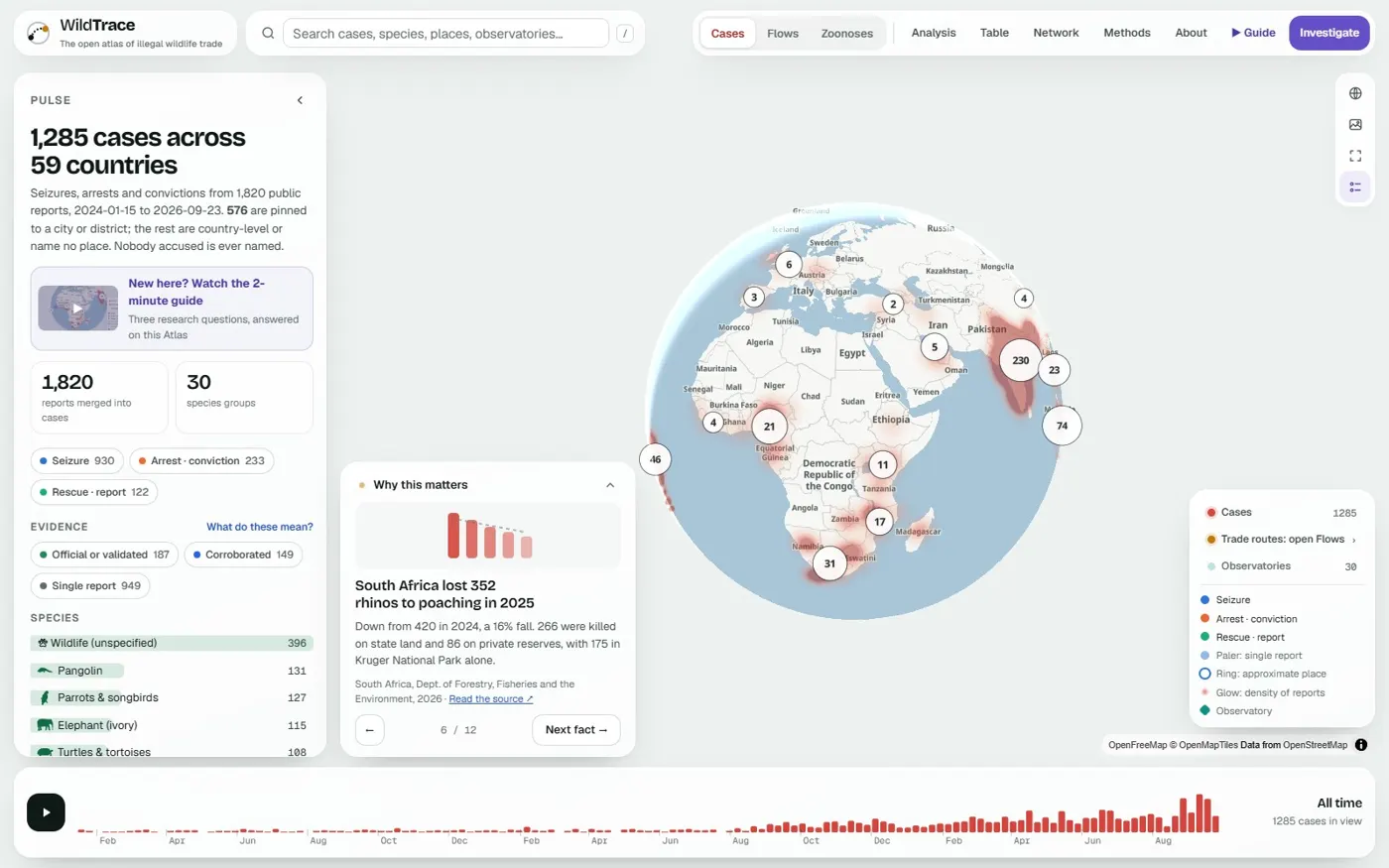
WildTrace atlas: a globe with clusters of wildlife seizure cases across Africa and Asia, a panel listing 1,285 cases across 59 countries, and a timeline of cases along the bottom

WildTrace is an open atlas of illegal wildlife trade. It maps seizures, arrests and convictions around the world, in animals and in plants , and grades every case by the strength of its evidence, so that a rumour and a conviction never look the same on the map.

It grew out of my years of monitoring trade by hand. A news report of a pangolin seizure tells you where someone was caught, and very little about where the animal came from. So WildTrace sets the cases against trade flows from the CITES Trade Database, and shows plainly where reporting is heavy and where it is thin. A zoonoses view places host species next to the trade, and it is careful to show co-location without claiming cause.

  • 1,200+graded cases, updated daily
  • 15,385seized shipments, CITES 2015–2024
  • Freeopen data and code

Why it matters. Journalists, researchers and small NGOs can follow the trade with the kind of link analysis that enforcement agencies pay for, and can see how strong the evidence is behind each case before they repeat it.

Newsletter archive and website · 2022 to 2024

Kalpavriksh’s Protected Area Update

Research Assistant, C-TARA, IIT Bombay, with Kalpavriksh · under the guidance of Prof. Pankaj Sekhsaria

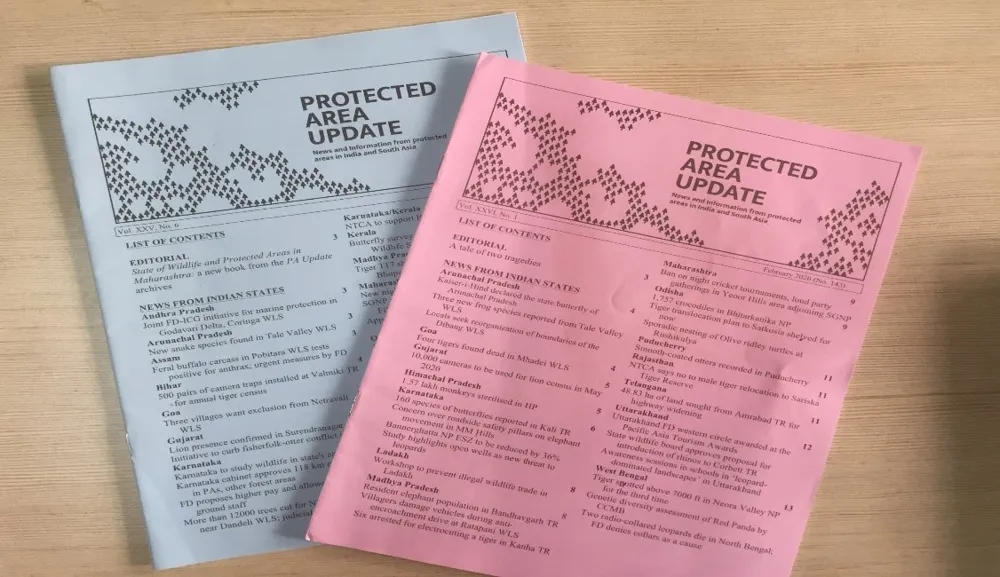
Two printed issues of the Protected Area Update newsletter by Kalpavriksh, listing news from India's protected areas state by state
Where it started: the printed newsletter.

With

  • Kalpavriksh Environment Action Group
  • C-TARA, IIT Bombay

Since the 1990s, the Protected Area Update newsletter from Kalpavriksh has recorded news from India’s national parks and sanctuaries, from tiger deaths to olive ridley nesting on the Odisha coast. It is a near three-decade record of more than 6,000 reports.

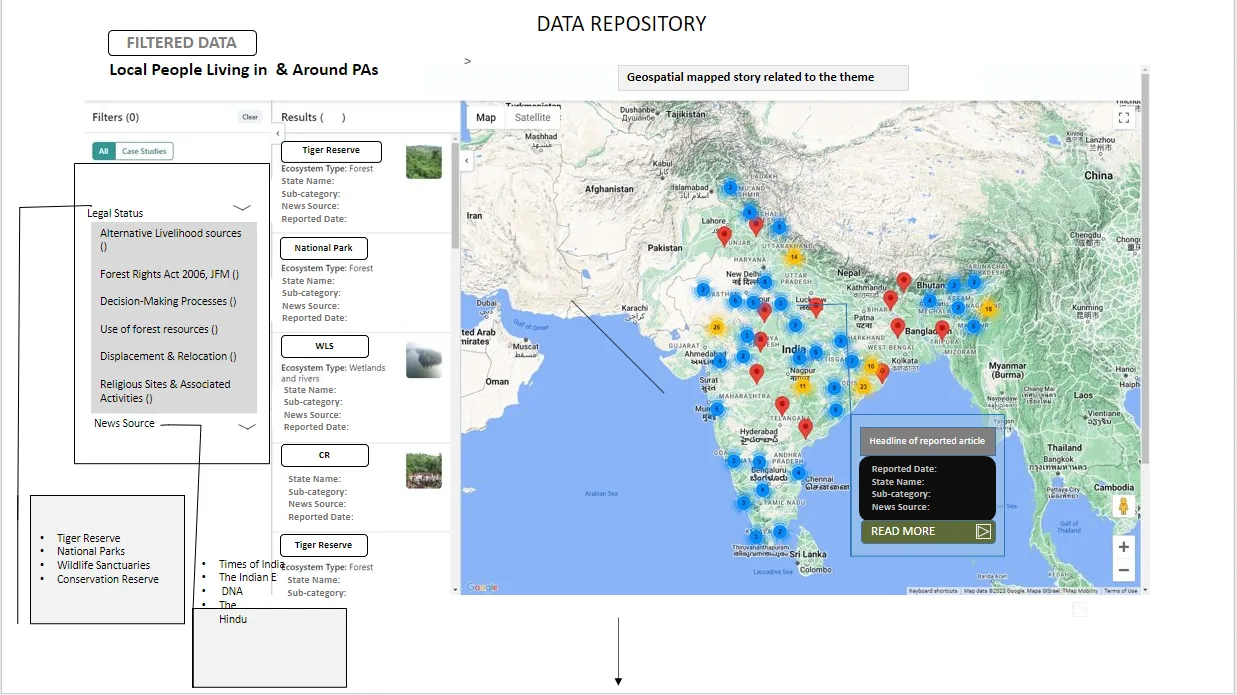
I turned that archive into a research-grade geospatial database in QGIS. I designed the coding framework, coded more than 1,000 reports for how the news constructs conservation, human–wildlife interaction and governance, and built the geospatial tagging and visualisation workflow behind the public website. I also sketched how its data repository should work: filters by legal status and theme, a list of results, and a map where each story opens where it happened.

Wireframe of the Protected Area Update data repository: filters by legal status and news source on the left, a list of results in the middle, and a map of India with clustered story markers on the right
My 2023 wireframe for the data repository.
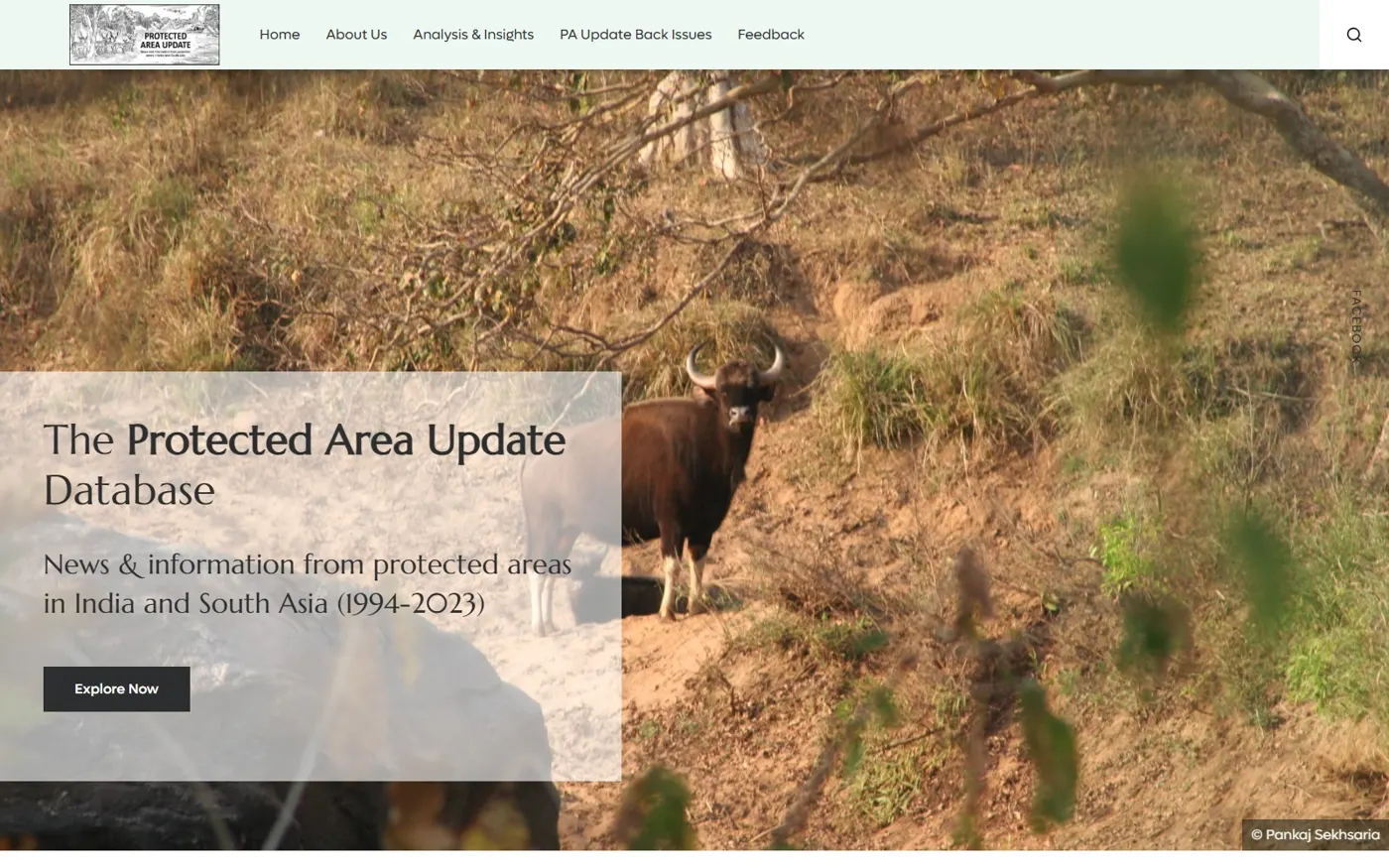
Home page of The Protected Area Update Database, news and information from protected areas in India and South Asia, 1994 to 2023, over a photograph of a gaur in dry forest
The public website today. Photograph © Pankaj Sekhsaria.
  • 6,000+reports in the archive
  • 1,000+coded by me
  • 1994–2023years of news

Why it matters. Three decades of local conservation reporting are now searchable and mapped for anyone: researchers, journalists and the communities the stories are about. I presented the work at the Central India Landscape Symposium in Kanha and at SCCS, IISc Bengaluru, in 2023.

Open-source app · 2026

Sift QDA

Creator · MIT or Apache-2.0

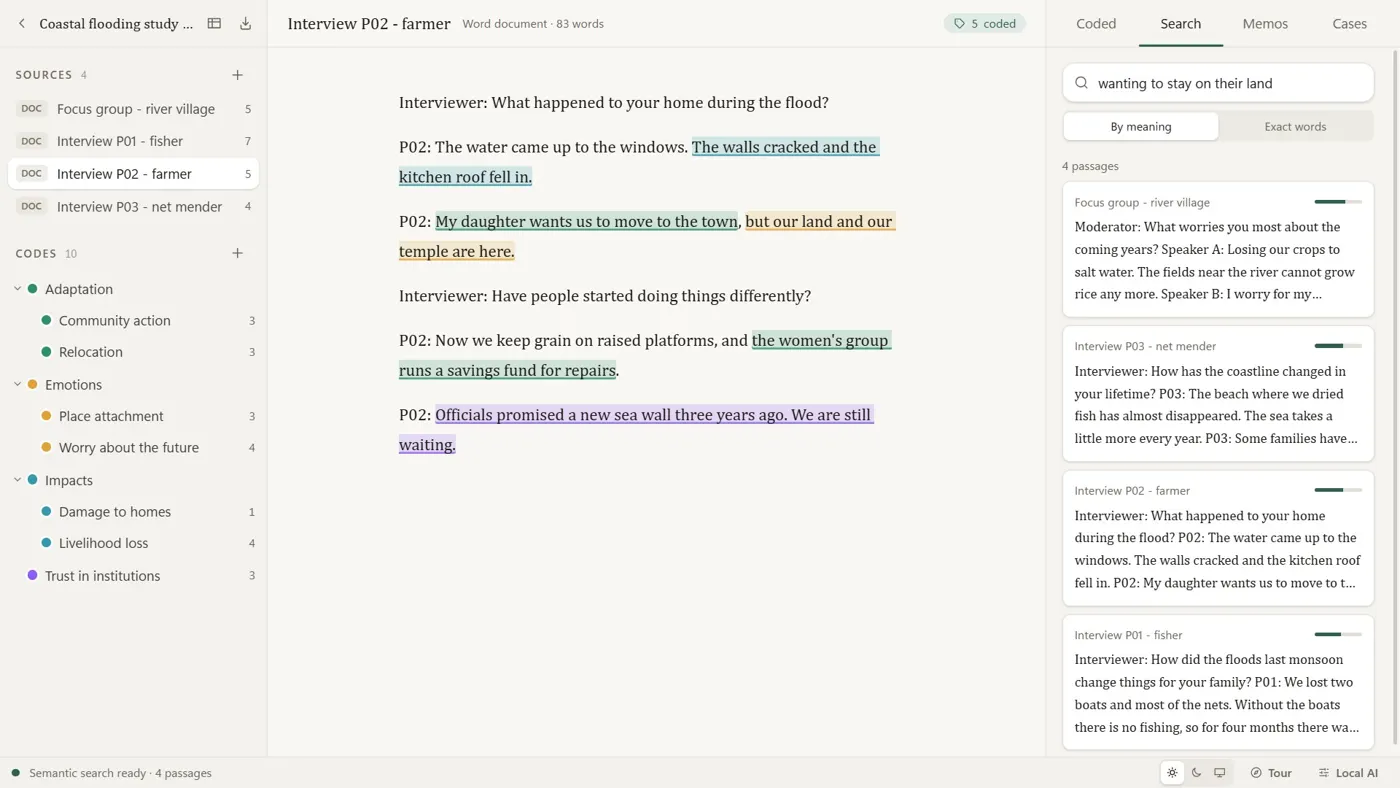
Sift QDA in the light theme: an interview with passages highlighted in theme colours, and a search by meaning listing related passages from four sources

I coded my Tide Turners interviews in NVivo, and a licence like that is out of reach for most students and small organisations in India. Sift QDA is my answer: a free qualitative data analysis app for Windows that codes interviews, PDFs and survey answers without the data ever leaving your computer.

It searches by meaning offline, so asking for “fear of losing income” finds the person who said they did not know how they would pay rent. Projects move to and from NVivo, ATLAS.ti and MAXQDA through the REFI-QDA standard, and one click exports every coded extract to Excel.

Why it matters. Students and NGOs can do careful qualitative research without paying for a licence, and interviews with sensitive details stay on their own machine, which is often what an ethics board asks for.

Evidence-gated AI · 2026

Kosma

Creator · MIT licence

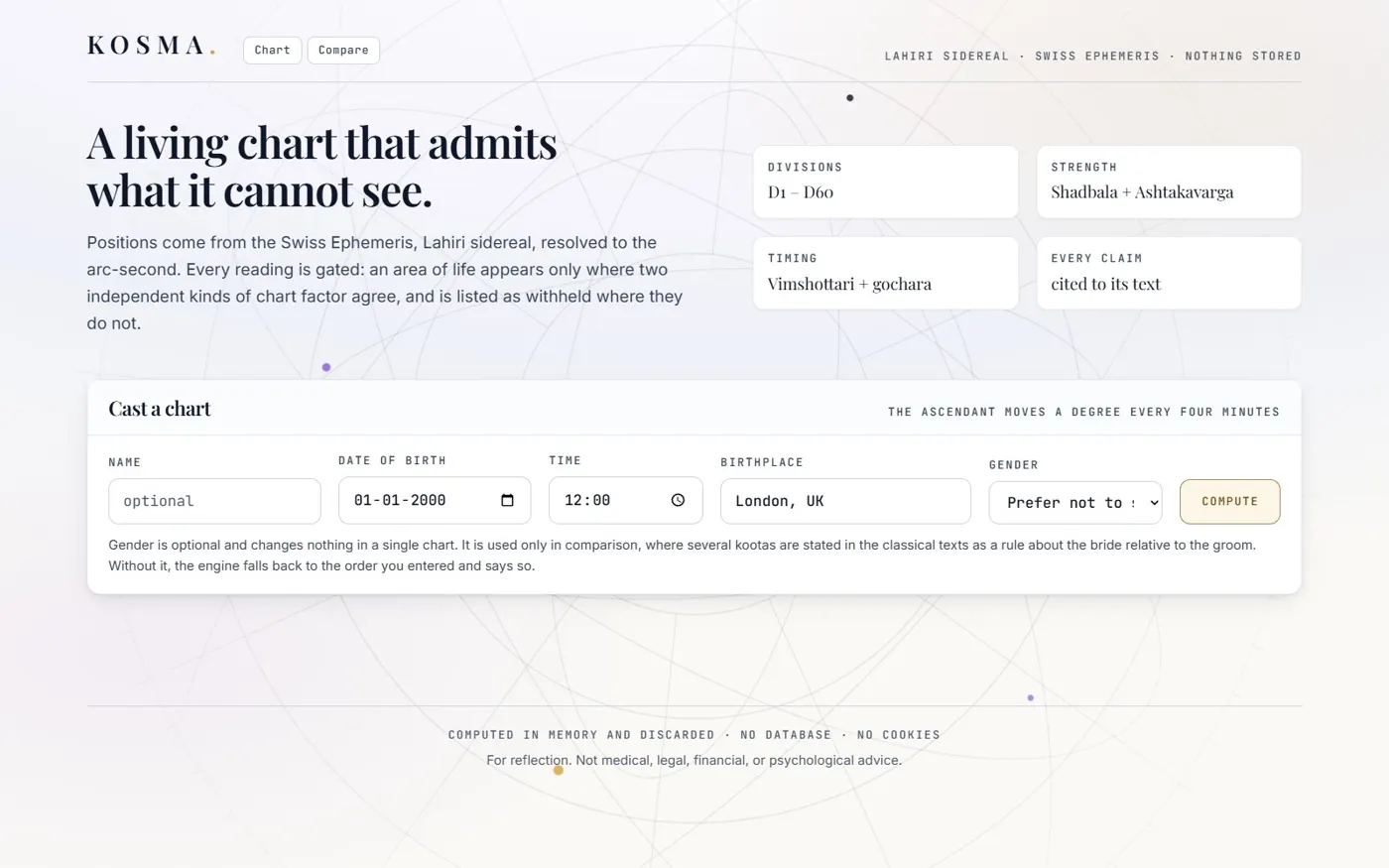
Kosma home page: 'A living chart that admits what it cannot see', with a form to cast a chart and a note that everything is computed in memory and discarded

Kosma is a privacy-first Vedic astrology engine and a side project about how to make an AI honest. The ephemeris computes a birth chart to arc-second precision, and the language model only interprets what the chart can support. Any reading that two independent chart factors do not confirm is withheld and listed as withheld, and every line can be traced back to its arithmetic and its source text.

Why it matters. It is a small working example of an AI that says what it cannot support, and that design choice matters far beyond astrology. It is the same rule I use in research: say what the record supports, and be open about what it does not. Nothing a user enters is stored.

earlier and ongoing

Trade monitoring · 2022 to 2023

Online wildlife trade in Indian languages

Technical Assistant, Counter Wildlife Trafficking programme, WCS-India

I built and ran the programme’s online monitoring pipeline, with a Python collection layer on the YouTube Data API. The keyword lists were in English, and the trade was not. With Hindi and Telugu speakers inside and outside the organisation, I compiled a lexicon of more than 50 trade codewords, mapping each one to its species and product, and credited the people who gave me the terms.

I hand-labelled more than 1,000 videos and trained a text classifier that reached 87% accuracy. The number I learned most from was a different one: it caught only 43% of the irrelevant clips, because four-fifths of my labels were positive. Alongside this I volunteered as an analyst with the Wildlife Crime Control Bureau.

Why it matters. Monitoring that works in the languages the trade actually uses finds what English-only systems miss.

Media observatory · ongoing

Species on Screen

Independent research · open source

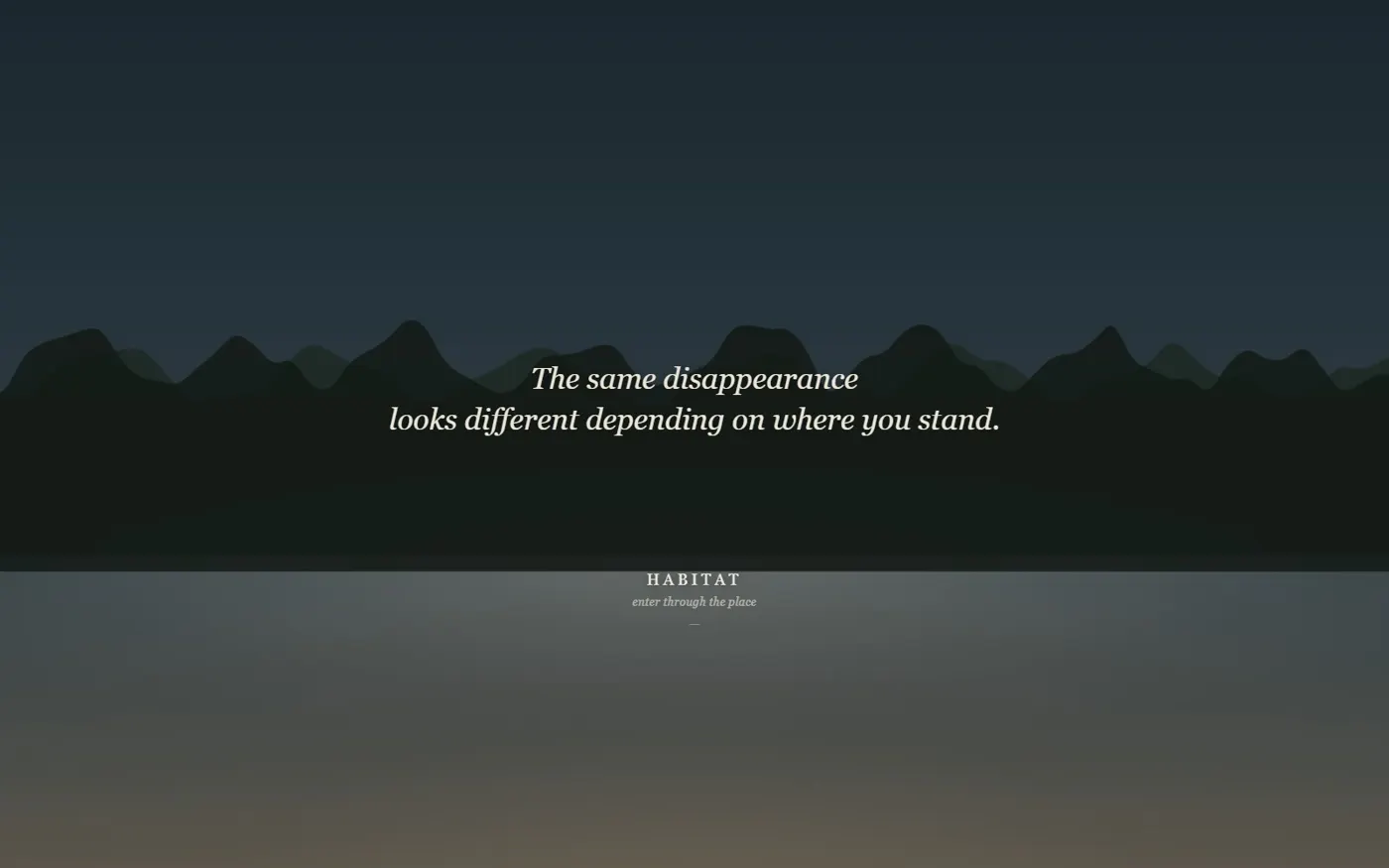
Species on Screen, Sundarbans page: a dusk landscape with the line 'The same disappearance looks different depending on where you stand'

Species on Screen asks how digital nature content, from documentaries to video games, shapes the way people engage with biodiversity. It pairs a quiet, cinematic reading surface with a research archive of attested observations, one place, one species and one source at a time. A first case study follows how people talked about beavers on YouTube before and after Pixar’s Hoppers (2026).

Why it matters. It tells conservation groups whether the attention nature media earns turns into care, or into demand.

M.Sc. dissertation · 2019 to 2021

Wildlife offences in Ranthambhore

University of Kota · supervised by Dr Satya Prakash Mehra, co-supervised by Dr Areendran Gopala (WWF-India)

With the Field Director’s permission, I obtained Ranthambhore Tiger Reserve’s enforcement records by field visit: 1,341 recorded offences from January 2015 to May 2021, in six categories from human disturbance and wood cutting to hunting. I georeferenced the patrol posts by GPS, mapped the offences as heatmaps in QGIS and assessed five surveillance technologies, from camera traps to M-STrIPES, against the data each returns.

Recorded offences fell from 225 in 2019 to 98 in 2020. The honest reading was that cases had stopped being registered under COVID-19, and I had no second record to set against it. That gap became the question behind everything on this page.

  • 1,341offences analysed
  • 2ndof 18 in the cohort